
SALES
Lead Nurturing for Coaches & Consultants: What to Do When Prospects Go Quiet
Most prospects don't say no, they go quiet. Learn how coaches and consultants can nurture leads after a discovery call using the content they already create.

Quick answer: Most prospects who do not buy after a discovery call have not necessarily rejected your offer. Many simply are not ready to make the decision yet. Lead nurturing for coaches and consultants means staying useful during that gap by sharing relevant ideas, stories, frameworks and expertise—rather than repeatedly asking, “Have you decided?”
Most leads don't say no. They just go quiet.
A prospect attends your workshop, books a discovery call, asks good questions about your offer and seems genuinely interested. But they do not buy.
Maybe they need more clarity. Maybe the timing is not right. Maybe they still need enough trust to make the decision.
So you follow up for a few days: a WhatsApp message, a reminder, maybe one more check-in. Then client work takes over. New enquiries come in, existing clients need attention and your sessions still have to be delivered.
Within one or two weeks, that prospect slowly disappears from your active pipeline.
The important part is this: their problem may not have disappeared just because your follow-up stopped.
Three months later, they may finally be ready to solve it. But by then, they may remember the coach or consultant who continued helping them think—not necessarily the person who first had the discovery call with them.
That is the opportunity. You do not necessarily need another complicated 90-day chase sequence, and you do not necessarily need to spend hours writing new content every week. You already create valuable ideas, stories, frameworks and advice during calls, workshops and client sessions.
A better system can capture that expertise and continue putting it in front of relevant prospects until their timing changes.
That is the idea behind Decision Nurture.
The real leak happens between interest and decision
Most sales systems pay attention to two moments: what happens before the call, and what happens immediately after it.
Before the call, the goal is to generate and qualify the lead. After the call, the goal is usually to follow up and close.
But there is another period that often receives very little attention: the period between “I'm interested” and “I'm ready.”
A prospect can understand what you offer and still not be ready to decide today. Another priority may be more urgent. They may still be evaluating the risk. They may need a clearer understanding of the problem. They may trust you, but not yet enough to commit.
None of those automatically means no.
Yet once a short follow-up cycle finishes, many businesses effectively treat that prospect as lost. The expensive work has already happened—you earned the attention, started the relationship and created initial trust—then the relationship fades because the buyer happened to be on a different timeline.
That is the hidden relationship gap.
Follow-up and lead nurturing solve two different problems
Direct follow-up is useful. After a discovery call, you should answer questions, clarify objections, send anything you promised and make it easy for a ready buyer to move forward.
The problem begins when the same type of communication continues long after that stage.
“Just checking in.” “Any update?” “Are you still interested?” “Have you made a decision?”
Those messages ask the prospect to make a decision. They do not necessarily help the prospect make a better decision.
Lead nurturing has a different job. It keeps helping the prospect understand the problem, the mistakes keeping them stuck, the alternatives available, what a good solution should look like, what risks matter and how an experienced practitioner thinks about the situation.

Follow-up asks: “Are you ready?”
Decision Nurture helps answer: “What do I still need to understand before I am ready?”
For coaches and consultants, that distinction matters because buyers are rarely purchasing only a list of features. They are purchasing judgment, expertise, trust and confidence in the person who will help them.
Not every quiet lead is the same
Traditional pipelines eventually push prospects toward two buckets: won or lost. Real buying behaviour is more nuanced.
A useful nurture system separates at least three states.
Not now
The prospect may be a good fit, but the timing is wrong. They may benefit from staying connected to your expertise without being pushed into another sales conversation every week.
Not sure
Interest exists, but clarity or confidence does not. This is where educational nurture can be particularly useful.
Not interested
There is a clear no, no meaningful need or poor fit. Respect it. Lead nurturing should never become an excuse to chase someone forever.

So what happens after direct follow-up ends?
There is no universal rule saying every coaching or consulting prospect should be followed up for exactly 14, 30 or 90 days. Offer price, urgency, complexity and buyer type all change the buying cycle.
A more useful approach is to change the type of communication.
Phase 1: Direct follow-up
Immediately after the call, answer questions, resolve obvious uncertainty, send promised material and help a ready prospect take the next step.
Phase 2: Decision Nurture
Once immediate follow-up has done its job, stop repeatedly asking for the sale and start staying useful.
That could mean sharing an observation from a recent workshop, a framework you explained to a client, a mistake you repeatedly see, an example of how you approach the problem, a story that changes how the prospect thinks or a practical explanation related to the service they are considering.
The prospect remains connected to your thinking, not trapped in your sales sequence.
But doesn't this create another content job?
Normally, yes. This is where many nurture strategies become unrealistic for coaches and consultants.
Someone tells you to send a newsletter every week. Now you need to find a topic, write it, edit it, format it, schedule it and repeat the entire process next week.
For someone already delivering client work, that quickly becomes another job.
But coaching and consulting businesses have an unusual advantage: you already create the raw content while doing the work you are paid to do.
You explain concepts during Zoom calls. You tell stories in workshops. You create frameworks while solving problems. You answer recurring questions in client sessions. You challenge assumptions and share observations from real work.
That is already valuable intellectual property. Most of it simply disappears when the meeting ends.
Your sessions can become the nurture engine
Instead of starting from a blank page every week, start from conversations that already happened.
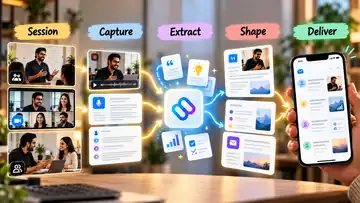
1. Session
Continue running your normal coaching calls, workshops, consulting sessions and Q&A sessions. No separate weekly content session is required.
2. Capture
Approved recordings are securely captured and transcribed. The goal is not to publish the conversation. The goal is to identify reusable expertise.
3. Extract
The system looks for valuable knowledge: stories, frameworks, explanations, strong opinions, useful examples, recurring problems and patterns.
4. Shape
The strongest idea is transformed into useful communication in your voice—not generic AI writing and not invented expertise.
5. Deliver
The right opted-in prospects or past clients receive the insight. When someone replies or becomes ready, automation should step aside and the human conversation resumes.
The purpose of automation is not to remove human judgment. It is to remove unnecessary production work around expertise you already created.
This is where AI is actually useful
The goal is not to ask AI, “Write me another newsletter about leadership.”
That creates more content. It does not necessarily create more expertise.
AI becomes much more useful when it works with expertise that already exists: the exact way you explain something, the analogy you naturally use, the pattern you repeatedly observe, the story that came from real work, the questions clients keep asking and the framework you use while solving the problem.
The authority still comes from the practitioner. AI helps capture, structure and distribute it.
The model is: Human expertise → AI-assisted extraction → Human-quality communication.
What should the prospect actually receive?
The communication should not feel like another automated campaign. It should feel useful.
A leadership coach might share an insight about why first-time managers struggle to delegate. A business consultant might explain why increasing lead volume will not repair a broken sales process. A career coach might explain when someone needs a new role versus an entirely new career. A marketing consultant might explain why more ad spend can create more wasted leads when the conversion process is broken.
None of those messages has to end with “Buy my service today.”
The value is that each useful interaction demonstrates something more important: this person understands my problem.
That compounds familiarity and trust. When the buyer eventually becomes ready, the relationship has not been sitting at zero for three months.
The newsletter is not actually the product
A newsletter is only the delivery format.
If you simply hire someone to manufacture four generic emails every month, you have outsourced content production. You have not necessarily created a nurture system.
A useful Decision Nurture system should answer one question:
After reading this, is the right buyer better equipped to understand their problem or make their decision?
If the answer is no, the content may still look good or get opens, but it is not doing the real job.
The same engine can keep past clients warm too
The relationship problem does not only happen before the sale.
A coaching program ends. A consulting project finishes. Everyone moves on. Six months later, that previous client may have another problem you could solve, but if communication disappeared completely, you now have to rebuild the relationship again.
The same expertise engine can help here too.
Prospects, active clients and past clients should not necessarily receive identical communication. They are in different contexts and should be segmented appropriately. But the underlying source can remain the same: your ongoing expertise.
That means one system can support both lead nurture and relationship retention.
Protect client privacy
Client calls can be useful source material, but the purpose is to reuse your expertise—not someone else's private information.
The workflow should include appropriate recording consent, removal of confidential details, anonymisation where necessary and human review before sensitive material is published.
A simple operating principle is:
Reuse your thinking. Never expose your client's identity.
What this system does not solve
Decision Nurture does not replace lead generation. It does not repair a weak offer. It cannot convert someone with no meaningful need. And it should never override a clear no.
The point is not to keep contacting everyone forever.
The point is to avoid losing a valuable relationship simply because the prospect's buying timeline was longer than your follow-up timeline.
A better lead journey
The traditional journey often looks like:
Lead → Discovery Call → Follow-Up → Convert / Lost
For many coaching and consulting businesses, one stage is missing:
Lead → Discovery Call → Short-Term Follow-Up → Decision Nurture → Convert when ready
The prospect is no longer being chased. They are simply continuing to learn from the person they are considering working with.
When timing changes, the relationship does not have to restart from zero.
What changes for the business?
A good nurture system can improve three things at once.
It extends the useful life of a qualified lead beyond the original discovery call. It allows a coach or consultant to communicate consistently without building a second job around content creation. And it turns conversations that would otherwise disappear into reusable business assets.
The important mindset shift is this:
You are not trying to send more email. You are trying to waste less of the attention, trust and expertise your business already creates.
You may not need more leads first
Lead generation will always matter. But before asking how to generate another hundred leads, there is another useful question:
What happens to the qualified people I already paid, worked or built a reputation to attract when they are not ready immediately?
If the answer is, “We follow up a few times and then they mostly disappear,” there is probably a system missing.
Not every quiet lead will buy. That is not the promise.
The promise is more practical: good-fit prospects should not forget you simply because they were not ready during the same two-week window in which you happened to be following up.
For coaches and consultants, the material needed to maintain that relationship may already be created every week—inside the work they are doing anyway.
Frequently Asked Questions
What is lead nurturing for coaches and consultants?
It is the process of staying useful to relevant prospects who are interested but not yet ready to buy. Instead of repeatedly sending sales reminders, the business continues sharing useful expertise until the buyer's decision becomes clearer.
How is lead nurturing different from follow-up?
Follow-up usually asks the prospect to take the next sales action. Nurturing continues helping the person understand the problem and build enough confidence to make a decision.
Can coaching calls be turned into newsletters?
Yes, provided recording, privacy and confidentiality are handled appropriately. The objective is to extract the coach's reusable expertise while removing identifying or sensitive client information.
Do I need to write a new newsletter every week?
That is exactly what this model is designed to reduce. Existing workshops, client calls and other sessions become the source material instead of starting from a blank document.
Does every cold lead belong in nurture?
No. A clear rejection or poor-fit prospect should not be chased. Nurture is primarily useful for good-fit prospects who are in a genuine not now or not sure state.
Can this also help with client retention?
Yes. The same expertise engine can maintain useful communication with past clients, provided prospects, active clients and past clients are segmented appropriately.